
70 lines
7.0 KiB
Markdown
70 lines
7.0 KiB
Markdown
---
|
||
link: https://en.wikipedia.org/wiki/Macun
|
||
author:
|
||
- "[[Contributors to Wikimedia projects]]"
|
||
published: 2009-10-16
|
||
created: 2026-03-24
|
||
description: confiserie turque à base de toffee
|
||
tags:
|
||
- t/clippings
|
||
---
|
||

|
||
|
||
Macun in Turkey
|
||
|
||
**Macun** (in [Turkish](https://en.wikipedia.org/wiki/Turkish_language "Turkish language") also **Macun şekeri**) is a soft, sweet and colorful [Turkish](https://en.wikipedia.org/wiki/Turkish_cuisine "Turkish cuisine") [toffee](https://en.wikipedia.org/wiki/Toffee "Toffee") paste.[^1] [^2] It is a street food that may be prepared with many herbs and spices. Macun originated from spicy preparations of [Mesir macunu](https://en.wikipedia.org/wiki/Mesir_macunu "Mesir macunu"),[^3] a traditional Turkish [herbal](https://en.wikipedia.org/wiki/Herbalism "Herbalism") paste from the [classical antiquity](https://en.wikipedia.org/wiki/Classical_antiquity "Classical antiquity") period. During classical antiquity, macun was consumed as a pharmaceutical [medicine](https://en.wikipedia.org/wiki/Medicine "Medicine"). It was historically served in a round tray with separate compartments for the various flavors, a serving style that has continued into modern times. The consumption of macun is a part of some Turkish customs.
|
||
|
||
## Overview
|
||
|
||

|
||
|
||
Macun
|
||
|
||
Macun is a [street food](https://en.wikipedia.org/wiki/Street_food "Street food") that is often sold outdoors,[^1] especially during [street festivals](https://en.wikipedia.org/wiki/Street_festival "Street festival") (*panayır*). It is a popular sweet among children.[^1] The color of various macuns may be vivid or bright.[^2] Macun may be prepared with a great deal of herbs and spices.[^4] Ingredients to flavor macun have traditionally included [bergamot](https://en.wikipedia.org/wiki/Bergamot_essential_oil "Bergamot essential oil"), cinnamon, [mastic](https://en.wikipedia.org/wiki/Mastic_\(plant_resin\) "Mastic (plant resin)"), mint, rose, lemon and plum.[^1]
|
||
|
||
## History
|
||
|
||
Macun originated from spicy preparations of [Mesir macunu](https://en.wikipedia.org/wiki/Mesir_macunu "Mesir macunu"),[^3] a traditional [herbal](https://en.wikipedia.org/wiki/Herbalism "Herbalism") paste from [classical antiquity](https://en.wikipedia.org/wiki/Classical_antiquity "Classical antiquity").[^1] During classical antiquity, macun was consumed as a pharmaceutical [medicine](https://en.wikipedia.org/wiki/Medicine "Medicine").[^1]
|
||
|
||
Macun was purported to have therapeutic effects to give the body strength and to calm one's spirit.[^1] Islamic physicians have prepared hundreds of different varieties of macun.[^1] The various herbs and spices used were mixed with honey in macun preparation, the latter of which also served to [preserve](https://en.wikipedia.org/wiki/Food_preservation "Food preservation") the product.[^1] Various macuns have been served and consumed as both a medicine and as a confectionery (sweetmeats).[^1] During the [Ottoman period](https://en.wikipedia.org/wiki/Ottoman_Empire "Ottoman Empire"), macun named *Neruz macunu*, also referred to as *nevruziyye*, was consumed as both a medicine and confectionery.[^1]
|
||
|
||
During the 17th century in Turkey, the [dervish](https://en.wikipedia.org/wiki/Dervish "Dervish") Seyyid Hasan denoted the consumption of two flavors of macun, respectively flavored with mint and [sweet flag](https://en.wikipedia.org/wiki/Acorus_calamus "Acorus calamus").[^1] These macun varieties were served at meals he consumed with other dervishes and friends.[^1] Hasan was a part of the Sunbuliyye [mystic](https://en.wikipedia.org/wiki/Mysticism "Mysticism") order, as its [sheikh](https://en.wikipedia.org/wiki/Sheikh "Sheikh").[^1]
|
||
|
||
## Service
|
||
|
||
|
||
|
||
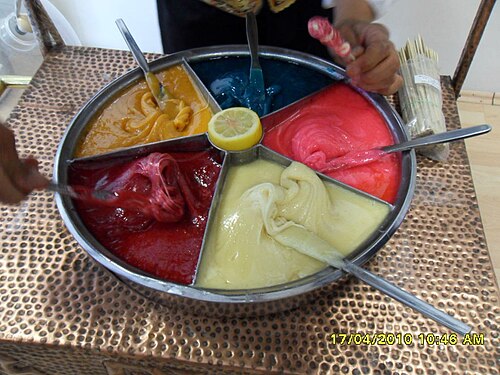
Macun being served in its traditional container
|
||
|
||
Macun is typically served in a round tin tray that has separate triangular-shaped compartments.[^1] It may be served by scooping using a *macuncu mablaği* or *macunkeș*, which is shaped like a screwdriver.[^1] The macun is scooped and then wrapped around a small stick.[^1] [^2] This may be done with alternate flavors, which creates a striped sweet.[^1] In Turkey, people that serve macun may be referred to as *macuncu*.[^1]
|
||
|
||
### History
|
||
|
||
In the past in Turkey, the serving trays were constructed from copper or wood, and [street vendors](https://en.wikipedia.org/wiki/Hawker_\(trade\) "Hawker (trade)") would stand the macun trays upon portable tripods.[^1] Others would carry macun in a container strapped to their waist with a belt, whereby the container had separate compartments for various flavors of the macun.[^1] Some macun vendors in [Istanbul](https://en.wikipedia.org/wiki/Istanbul "Istanbul"), Turkey, would try to attract customers and compete with other vendors by playing music.[^1] Street vendors would purvey macun to people at the [Hıdırellez](https://en.wikipedia.org/wiki/H%C4%B1d%C4%B1rellez "Hıdırellez") spring festival, on market days, holidays, at wedding processions,[^1] and at other times.
|
||
|
||
## Customs
|
||
|
||
In the [Anatolia](https://en.wikipedia.org/wiki/Anatolia "Anatolia") region, it is a wedding custom for the groom to eat macun on the night of his wedding.[^4] The mesir bayrami ceremony in [Manisa](https://en.wikipedia.org/wiki/Manisa "Manisa"), Turkey, involves the distribution of macun to people on the streets.[^4]
|
||
|
||
## See also
|
||
|
||
- [List of Turkish desserts](https://en.wikipedia.org/wiki/List_of_Turkish_desserts "List of Turkish desserts")
|
||
- [List of desserts](https://en.wikipedia.org/wiki/List_of_desserts "List of desserts")
|
||
|
||
## References
|
||
|
||
## Further reading
|
||
|
||
- ["Şişli'de iftar vakti"](http://www.cumhuriyet.com.tr/haber/yasam/304217/Sisli_de_iftar_vakti.html). *Cumhuriyet Gazetesi* (in Turkish). June 22, 2015. Retrieved December 27, 2015.
|
||
|
||
## External links
|
||
|
||
- [Ottoman toffee](http://nezihtavlas.deviantart.com/art/Ottoman-Toffee-388250328)
|
||
|
||
[^1]: Isin, M. (2013). [*Sherbet and Spice: The Complete Story of Turkish Sweets and Desserts*](https://books.google.com/books?id=YHj-Mdv432UC&pg=PA86). I. B. Tauris. pp. 86– 90. [ISBN](https://en.wikipedia.org/wiki/ISBN_\(identifier\) "ISBN (identifier)") [978-1-84885-898-5](https://en.wikipedia.org/wiki/Special:BookSources/978-1-84885-898-5 "Special:BookSources/978-1-84885-898-5").
|
||
|
||
[^2]: Goldstein, D.; Mintz, S. (2015). [*The Oxford Companion to Sugar and Sweets*](https://books.google.com/books?id=XPNgBwAAQBAJ&pg=PA1290). Oxford University Press. p. 1290. [ISBN](https://en.wikipedia.org/wiki/ISBN_\(identifier\) "ISBN (identifier)") [978-0-19-931362-4](https://en.wikipedia.org/wiki/Special:BookSources/978-0-19-931362-4 "Special:BookSources/978-0-19-931362-4").
|
||
|
||
[^3]: ["The Turkish sweet tooth"](http://www.dailysabah.com/food/2014/11/24/the-turkish-sweet-tooth). *DailySabah*. November 24, 2014. Retrieved December 27, 2015.
|
||
|
||
[^4]: Önen, Ü. (1991). [*Turkey*](https://books.google.com/books?id=OzotAQAAIAAJ&q=Macun+toffee). Akademia Yayıncılık. p. 65.(subscription required) |